
When you invest in a beautiful piece of jewellery, you’re not just buying a design—you’re buying a promise of quality, craftsmanship, and genuine materials. In the UK, that promise is officially guaranteed by a tiny, yet incredibly significant, set of symbols: the hallmark. Far from being just a decorative flourish, a UK hallmark is a legal requirement for precious metal items, offering unparalleled consumer protection and a fascinating glimpse into the history of your cherished piece of jewellery.
What is Hallmarking and Why Does it Matter?
At its heart, hallmarking is a system of testing and marking articles of precious metal to guarantee their purity and origin. It’s one of the oldest forms of consumer protection in the world, dating back to the 1300s in the UK.
Why is it so important? Because precious metals like gold, silver, and platinum are often mixed with other metals (alloys) to make them more durable and workable or to achieve a particular colour. Hallmarking ensures that what you’re buying is exactly what it claims to be, protecting you from misrepresentation and ensuring you get true value for your investment.
For any item over a certain weight (1g for gold and platinum, 7.78g for silver), a hallmark is a legal necessity if it’s to be described as a precious metal in the UK.
Quick Reference: UK Hallmarks at a Glance
| Metal | Fineness Marks | Shape | Traditional Symbol |
|---|---|---|---|
| Gold | 375 (9ct), 585 (14ct), 750 (18ct), 916 (22ct) | Oval | Crown |
| Silver | 925 (Sterling), 800, 958, 999 | Oval | Lion Passant |
| Platinum | 850, 900, 950, 999 | Pentagon | Orb & Cross |
| Palladium | 500, 950, 999 | Three vertical circles | Pallas Head |
Decoding the UK Hallmark: The Compulsory Symbols
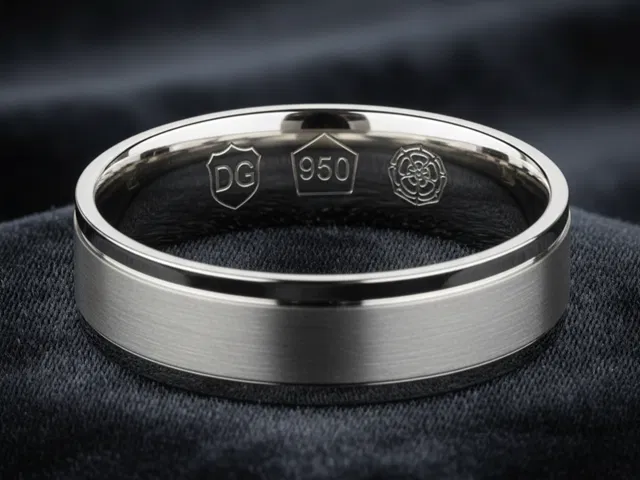
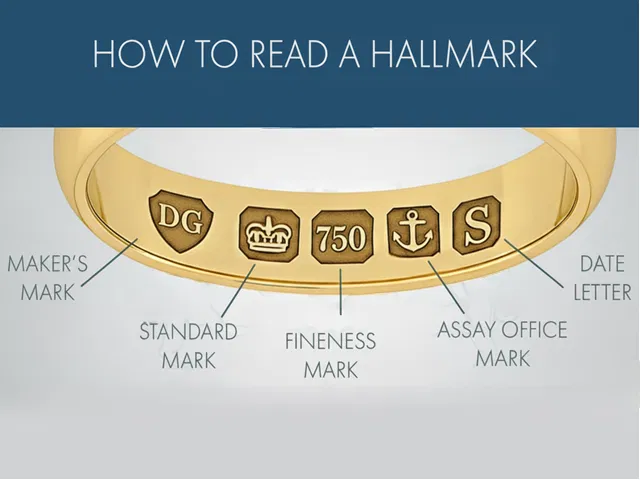
A full, traditional UK hallmark tells a story through three compulsory symbols:
1. Sponsor’s Mark
This is unique to the maker or importer of the item, allowing for full traceability back to its origin. It’s usually two or more letters within a shield.
2. Standard Fineness Mark
This indicates the precious metal and its purity (fineness) in parts per thousand. The shape around the number also denotes the metal—an oval for gold, a pentagon-like shape for platinum, three circles for palladium. Refer to the quick reference table above for all four metals.
3. Assay Office Mark
This tells you where the item was tested and marked. The UK has four active assay offices, each with its own distinctive symbol:
- London: A leopard’s head
- Birmingham: An anchor
- Sheffield: A rose
- Edinburgh: A castle
How Hallmarks Are Applied: Struck vs Laser
The look of the final hallmark is determined by the method used to apply it.
Struck Hallmarks (Traditional): Applied using a heavy press and a steel punch, these create a distinct physical indent into the metal. They’re perfect for robust, thicker jewellery pieces that can withstand the force of the strike—ideal for solid wedding bands and heavier signet rings.
Laser Hallmarking (Modern): Applied using a high-powered laser, this method is often used for modern or delicate items, such as thin wedding bands, hollow pieces, or items with intricate design work that might be damaged by striking. It burns the mark onto the surface of the metal, creating a clean, crisp mark without distorting the metal.
Some modern hallmarks may feature fewer symbols, but the core information about fineness and assay office is always present.
Designing a Bespoke Piece?
Every piece we make in our Bourton-on-the-Water workshop is sent to a UK assay office and properly hallmarked before it reaches you. Start designing yours with our free Ring Maker tool, or speak to our designers about a fully bespoke commission.
Beyond the Compulsory: Optional Hallmark Symbols
While the compulsory marks provide the essential guarantee of purity and origin, a UK hallmark can sometimes carry additional, optional symbols that add further value or historical context to a piece.
The Date Letter
This letter changes annually on 1st January and denotes the specific year the item was hallmarked. Although it became optional in 1999, it remains a highly valued tradition by collectors, dealers, and manufacturers alike, as it’s the simplest way to accurately date an item and connect it to a specific year in history.
Traditional Fineness Marks
You might still encounter older, optional traditional symbols like the Crown for gold or the Lion Passant for sterling silver, often applied today alongside the modern numerical fineness mark for a touch of heritage.
Commemorative Marks
These are truly special. Occasionally, the Assay Offices introduce unique marks to celebrate significant national events, such as a Royal Jubilee. These limited-edition symbols are only applied for a specific period, making pieces bearing them highly collectible and a wonderful way to mark a moment in time.
The Story of Palladium’s Hallmark
Palladium is the newest precious metal to receive its own UK hallmark, officially recognised on 22nd July 2009 under an amendment to the Hallmarking Act 1973. As part of the platinum group of metals, palladium is tarnish-resistant, naturally white, and durable—but lighter and more affordable than platinum. Read our full story on how palladium got its official hallmark and what it means for modern jewellery.
Special Considerations for Mixed Metal Jewellery
Modern designs often blend different precious metals—a trend known as mixed metals. The UK hallmarking system has clear rules for these complex pieces to ensure complete transparency.
Separate Marks: Each different precious metal present in the piece—for example, a platinum head on a yellow gold band—must be tested separately with its own fineness mark and metal symbol applied to the finished piece.
Dominant Metal Requirement: If the entire item is submitted as one piece, the assay office will usually apply a single assay office mark and date letter, but all the individual precious metal parts must meet the minimum weight requirements for hallmarking.
Clear Disclosure: This separate marking guarantees that you can clearly identify the purity of every precious metal used in your two-tone or multi-metal jewellery—an important consideration when commissioning a bespoke piece.
The Assurance of Authenticity
In an age where online shopping is prevalent, the physical presence of a UK hallmark is more important than ever. It’s your guarantee that an independent third party—the Assay Office—has verified the metal content. This eliminates guesswork and ensures complete transparency. This commitment to proven quality is exactly why, here at CompareTheDiamond.com, every piece of precious metal jewellery we offer is fully and properly hallmarked.
When purchasing jewellery, especially from online retailers or second-hand sources, always look for the hallmark. This tiny detail is a testament to quality, authenticity, and enduring value, safeguarding your investment and connecting your new treasure to centuries of British tradition and integrity.
Frequently Asked Questions About UK Hallmarks
What is the hallmark for platinum?
The UK platinum hallmark is a three-digit fineness number (most commonly 950, sometimes 900 or 999) inside a pentagon-shaped surround, accompanied by the sponsor’s mark and the assay office symbol. Most of our platinum wedding bands and platinum engagement rings carry a 950 hallmark.
What is an old platinum hallmark?
Platinum hallmarking only became compulsory in the UK in 1975, so any piece older than this may not carry a platinum-specific mark. Items from 1975 onwards typically show 950 or 999 inside a pentagon outline. Pre-1975 platinum pieces may carry the word "PLATINUM" stamped in full, or no hallmark at all even though they’re genuine platinum.
What hallmark does white gold have in the UK?
White gold uses the same hallmarks as yellow or rose gold—the marking refers to the gold content, not the colour. The colour is achieved by alloying gold with white metals like palladium or nickel and rhodium plating the finished piece. Look for 375 (9ct), 585 (14ct), or 750 (18ct) inside an oval surround.
What do the numbers on a gold hallmark mean?
The numbers indicate the gold content in parts per thousand. 750 means 75% pure gold (18ct), 585 means 58.5% pure gold (14ct), and 375 means 37.5% pure gold (9ct). Higher numbers indicate purer gold. Read more about why 18ct gold is the standard for fine jewellery.
Are all UK jewellery pieces hallmarked?
Only items above the legal minimum weight require a hallmark: 1g for gold, 1g for platinum, 1g for palladium, and 7.78g for silver. Very small items like thin chain links or delicate earring posts may be exempt, but any precious metal item over those weights must legally be hallmarked to be sold as such in the UK.
Where can I verify a UK hallmark?
You can verify any UK hallmark through the four active assay offices—London (Goldsmiths’ Hall), Birmingham, Sheffield, and Edinburgh. Each office maintains records of registered sponsor’s marks. Reputable retailers should also be happy to explain the hallmarks on any piece they sell.
Shop Properly Hallmarked Jewellery
| Wedding Rings Shop by metal |
Engagement Rings Platinum, gold & more |
Bespoke Jewellery Designed & hallmarked in Britain |
Design Your Own Free 3D Ring Maker |