
Most people fixate on the four Cs (carat, cut, colour, and clarity) when buying a diamond, and while they are incredibly important, if you stop there, you’re missing the point. The greatest jewel in the world can be let down by a poor setting. At its core, a diamond ring isn’t just jewellery; it’s a tiny, intricate piece of wearable architecture, and the setting is the blueprint for its enduring beauty.
At CompareTheDiamond.com we’d like to look beyond the sparkle to celebrate the designers and bench jewellers, the true unsung heroes whose skill turns a raw diamond and a band of metal into a lasting legacy.
The Visionary: Jewellery Designers and the Art of Proportion
Before the bench jeweller even touches the metal, a crucial stage unfolds: design. A skilled jewellery designer isn't just sketching pretty pictures; they are translating abstract beauty into a tangible, wearable structure. This involves a deep understanding not only of a client’s unique vision but also of aesthetics, ergonomics, and the science of light.
- Proportion is Paramount: Just as a grand building relies on perfect proportions to feel balanced and imposing, so too does a ring. The width of the band, the height of the setting, the relative size of side stones to the main diamond, every element is carefully considered. An ill-proportioned ring can make a beautiful diamond look awkward or smaller than its carat weight suggests.
- The Golden Ratio in Gemmology: Many master designers intuitively, or explicitly, incorporate principles like the Golden Ratio (Phi, approximately 1.618). This ancient mathematical ratio, found throughout nature and classical art, is believed to create objects that are inherently pleasing to the human eye. Applying it to the curve of a band, the taper of shoulders, or the spacing of diamonds ensures a harmonious and timeless design that never goes out of style.
- Balancing Form and Function: A designer must also consider the practicalities. How will the ring feel on the finger? Will it snag? Is it comfortable for daily wear? These ergonomic considerations are woven into the aesthetic choices, ensuring the ring is not just beautiful but also a joy to wear.
The Unsung Craft: The Bench Jeweller's Precision
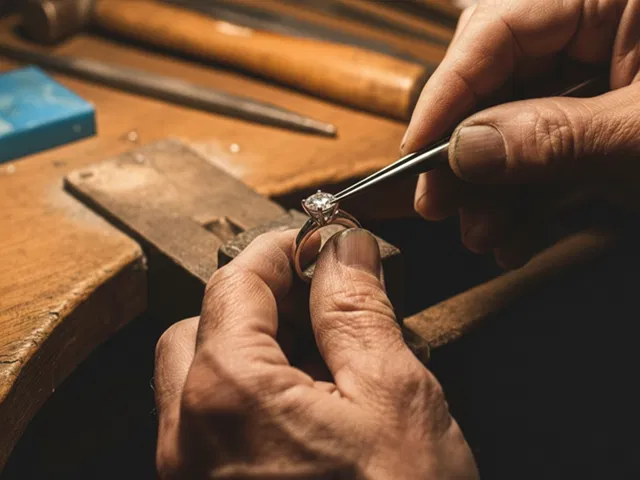
When you look at a piece of jewellery from Compare the Diamond, you're not looking at a mass-produced, machine-made component. You're seeing the result of many hours of meticulous work, all carried out by hand. The process of creating a perfect setting is called bench work, and it requires precision measured in fractions of a millimetre.
The true genius lies in the details often invisible to the naked eye:
- The Casting and Cleanup (Fettling): After the metal is cast from a mould, the raw piece is called a 'casting'. Before any setting can begin, the jeweller must meticulously clean this rough form. This vital cleanup, often called fettling, removes all casting imperfections and ensures the basic structure is perfectly true and balanced, laying a flawless foundation for the rest of the work.
- The Pre-Polish: To ensure a deep, mirror-like finish, the jeweller must polish all surfaces before the diamond is set. This prevents hard-to-reach areas, like the tiny space beneath the setting (the gallery), from being dull, ensuring the entire piece reflects light beautifully.
- The Seat Cutting: This is the critical stage. The jeweller must carefully carve a tiny, precise 'seat' or groove in the metal where the diamond will rest. If the seat is uneven, the diamond will wobble, sit crookedly, or, worst of all, be vulnerable to chipping along the edge.
- The Final Setting: After the seat is cut and the diamond is placed, the jeweller must carefully push the metal claws over the diamond's edge using specialised tools. This requires immense focus to secure the stone tightly without damaging it, confirming its stability and symmetry.
- The Final Polish and Finish: A master jeweller knows that a flawless final polish isn’t just about shine; it’s about structural integrity. The final, high-gloss finish is a seal of quality, ensuring the setting is smooth to the touch, secure, and prepared to last a lifetime.
A poorly finished setting can scratch skin, snag clothing, or worse, cause the stone to loosen and fall out. The hallmarks of a true master jeweller are the smooth finish, the symmetry, and the secure, seamless join between the diamond and the metal.
The Engineering of Sparkle: Claw vs. Bezel vs. Tension
On any piece of jewellery, the job of the setting is threefold: to protect the diamond, to securely hold it, and most critically, to maximise its brilliance. This last point is where physics meets artistry. Every setting style is a distinct structural solution to the challenge of holding a stone while showcasing its light.
- The Open Plan, The Claw Setting: The most popular choice for solitaire engagement rings, the claw setting (or 'prong') is a feat of engineering designed to do one thing: let in light. Typically using four or six tiny claws of metal, it holds the diamond securely at its girdle (the stone's edge). The minimal metal coverage means light can flood the stone from nearly every angle, allowing its natural fire and scintillation to put on a spectacular show. A good claw setting should be sturdy but invisible, blending into the geometry of the diamond itself.
- The Fortress, The Bezel Setting: The architectural opposite of the claw. Instead of minimising metal, the bezel encircles the entire diamond or a significant portion of it with a thin, custom-fitted strip of metal. While it might slightly reduce the light entering the sides, it offers unparalleled protection and durability. It’s the perfect choice for someone with an active lifestyle, and its clean, sweeping lines offer a distinctly modern and minimalist aesthetic.
- The Cantilever, The Tension Setting: This is arguably the most dramatic form of jewellery architecture. In a tension setting, the diamond appears to float between the two sides of the band. There are no visible claws or bezels; instead, the metal band is specially alloyed and notched to exert a tremendous, precisely calculated force, the namesake tension, to grip the stone. This futuristic look requires immense precision and a deep understanding of metal stress and diamond durability, transforming the band itself into the structural support.
The Historical Blueprints: How Architecture Shaped Jewellery
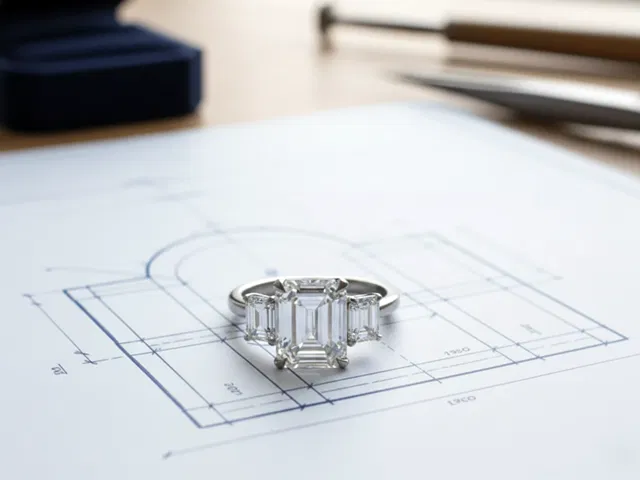
Throughout history, jewellery design has mirrored the grand architectural movements of the time. This is no coincidence; both disciplines rely on geometry, proportion, and form:
- The Victorian Era: Loved the complexity of the Gothic and Renaissance Revival, leading to intricate filigree settings that mimicked cathedral stonework.
- The Art Deco Period (1920s): Saw the rise of the skyscraper. Rings became bold, symmetrical, and angular, featuring strong lines and geometric cuts like the Asscher and Emerald, celebrating the form of the stone.
- Contemporary Design: Embraces clean, purposeful lines, echoing modern minimalist architecture where function and form are one.
Elevating Quality: Why Craftsmanship Matters More than Carat
At the end of the day, a magnificent diamond deserves magnificent support. A cheap, mass-produced setting will never hold a candle to one hand-crafted by an expert. It's the attention to structural integrity, the subtle balance of proportions, and the polished finish that elevate a piece from a trinket to a future heirloom.
We invite you to appreciate the architectural genius in every piece of jewellery we offer. Because when you choose a diamond from us, you’re not just investing in a stone; you’re investing in the highest level of design and enduring, world-class craftsmanship.