
For decades, the search for the perfect engagement or wedding ring involved a single, weighty decision: yellow gold, white gold, rose gold, or platinum? It felt like a lifetime commitment to one tone.
But what if you didn't have to choose?
Enter the mixed-metal ring. More than just a trend, dual-tone designs represent a profound shift in modern jewellery. They are the ultimate statement of individuality, style, and—most beautifully—unity.
If you are drawn to the warmth of gold but love the brilliance of platinum, the mixed-metal design is your perfect fit. Here is why these contemporary classics are soaring in popularity and what they symbolise.
The Symbolism: Two Halves, One Whole
The most compelling reason to choose a dual-tone piece is the story it tells. In a world of matching couples and coordinated colours, the mixed-metal ring celebrates complementary contrasts.
Think about it: the deep, enduring luxury of Yellow Gold alongside the sleek, modern lustre of Platinum. These two distinct elements come together not to clash, but to enhance one another. This is powerful symbolism, particularly for a wedding or engagement ring. It represents two unique individuals—with different tastes, backgrounds, and personalities—joining together to form a beautiful, stronger union.
The ring becomes a quiet, daily reminder that your differences are what make your partnership so rich.
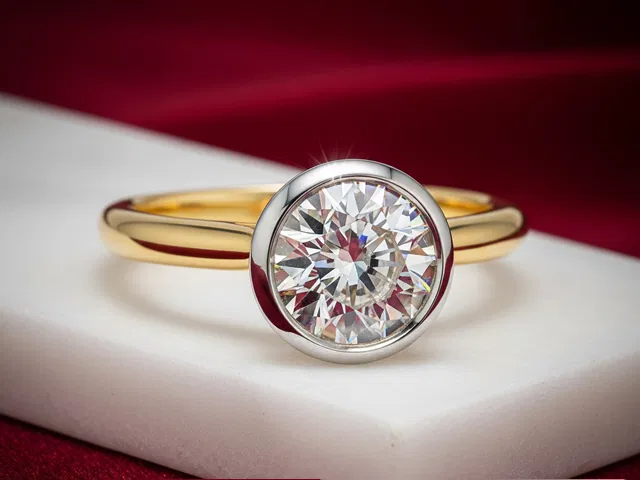
A Design Trick That Makes Diamonds POP!
From a purely aesthetic point of view, mixed metals are a jeweller’s secret weapon, especially when dealing with the brilliance of diamonds.
The secret lies in the different jobs the metals perform:
- The Head: The claws or setting that holds the main diamond (known as the head) are often crafted in White Gold or Platinum. This silvery-white tone acts as a mirrored backdrop, reflecting light up into the diamond, enhancing its colour and making it appear bigger and brighter.
- The Band: The shank or band of the ring, the part you slip over your finger, is often made from a warmer tone, such as Rose Gold or Yellow Gold. This provides a beautiful contrast that grounds the piece, allowing the diamond in its white setting to truly stand out.
You get the best of both worlds: maximum sparkle on the stone, and the warm, flattering glow of gold on your hand.
Design Freedom: Creating a Truly Unique Ring
The greatest power of the mixed-metal concept lies in its ability to allow for true customisation.
We understand that you don't just want a ring; you want your ring—a piece tailored precisely to your vision. Dual-tone construction allows you to break free from traditional single-metal constraints and hand-select the perfect combination for your stone and style:
- Platinum Bands with a Rose Gold Head: This combination is deeply romantic. The durable, hypoallergenic platinum gives you peace of mind for the band, while the rose gold head adds a distinct, warm flush of colour right beneath the central stone.
- Yellow Gold Bands with a White Gold Halo: Here, the yellow gold anchors the ring with classic warmth, while the white gold halo setting ensures that the surrounding accent diamonds, and the centre stone, achieve maximum white brilliance.
The flexibility of dual-tone design means you can mix and match to highlight a diamond's cut, complement a specific gemstone, or simply match the piece to your unique jewellery wardrobe. It is customisation made simple, resulting in a piece that is truly yours.
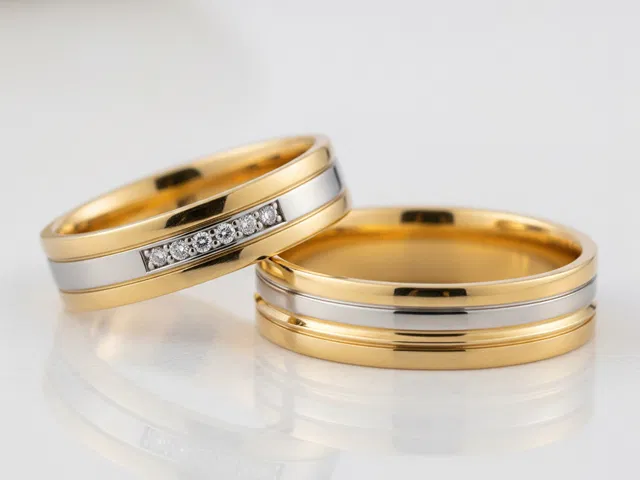
The Mixed-Metal Wedding Band: The Ultimate Compromise
The dual-tone design is never more meaningful than when chosen for a wedding band. It provides the perfect solution for two of the most common dilemmas facing couples:
1. Bridging the Gap Between Rings
If your engagement ring is entirely white gold, but you adore the look of classic yellow gold, a mixed-metal wedding band offers the perfect bridge. A band featuring both white gold (to sit neatly against the engagement ring) and yellow gold (to satisfy your preference) will create a seamless, harmonious set. It ensures your rings look perfectly matched without forcing a style choice you don't love.
2. Solving the Couple's Clash
What happens when one partner wants a sleek platinum band and the other desires a traditional yellow gold band? The dual-tone design is the answer. By selecting complementary mixed-metal bands—or even two entirely different bands that share one common metal colour—you acknowledge individual tastes while visually uniting your commitment. It is the perfect sartorial symbol of coming together without sacrificing identity.
Which Dual-Tone Combo Is Right for You?
While the possibilities are vast, a few classic combinations define the dual-tone look:
- Yellow Gold & Platinum/White Gold: The traditional pairing. Elegant, timeless, and provides the highest contrast for the main diamond.
- Rose Gold & White Gold: The romantic choice. The blush pink of the rose gold paired with white metal creates a soft, contemporary aesthetic that is extremely flattering on all skin tones.
- Matte & Polished: While not different metals, combining finishes on the same metal (e.g., a brushed band with polished edges) creates a sophisticated dual-texture effect, often found in modern men’s bands.
The mixed-metal ring is more than just a piece of jewellery; it’s a modern masterpiece that embraces contrast, functionality, and enduring style. It proves that when two different elements come together, they can create something truly spectacular. Stop settling for single-tone standards. CompareTheDiamond.com is here to prove that when it comes to forever, you truly can have it all.